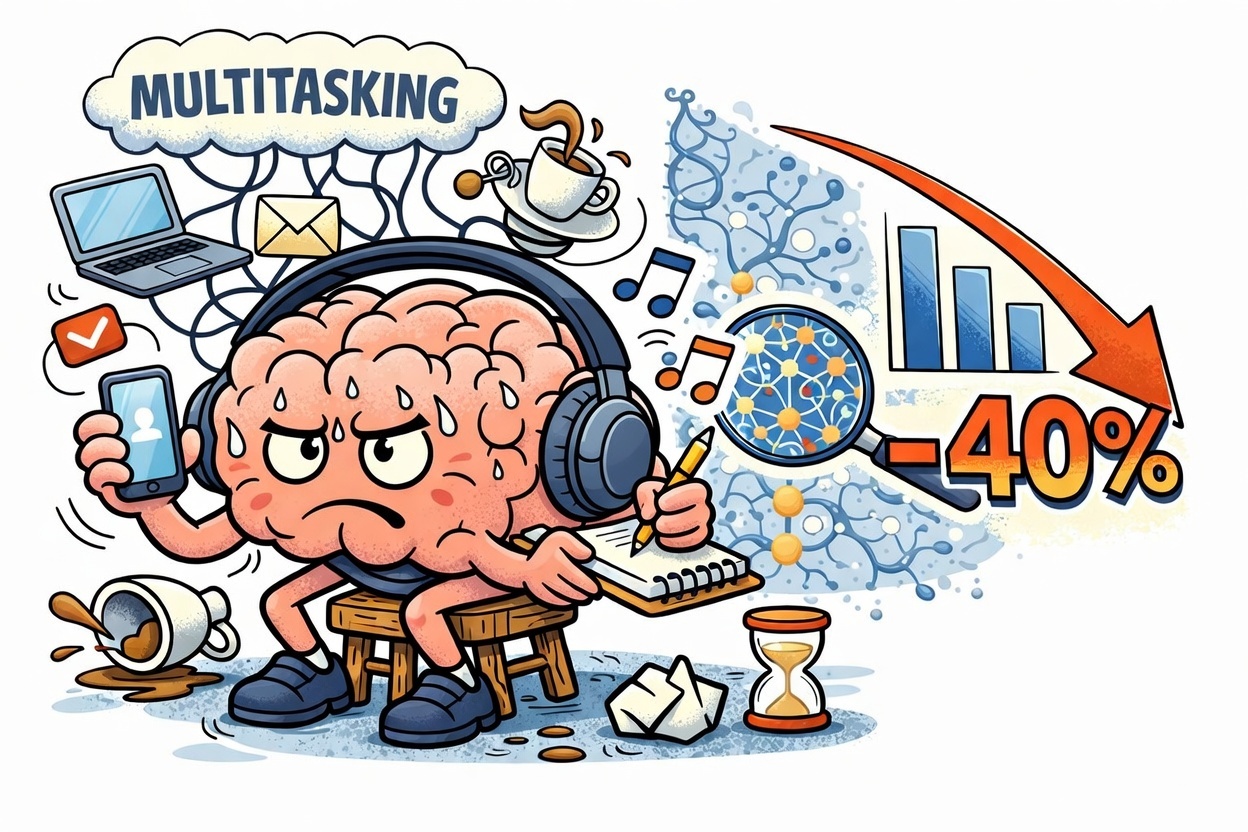
Multitasking sounds efficient, but for most attention-heavy tasks it usually means rapid switching, not true parallel performance. That switch has a cost: less speed, more errors and more mental fatigue.
Quick answer
Yes, multitasking often makes you less productive when both activities require attention, decisions or memory. The biggest problem is not just slower speed. It is also lost context, lower accuracy and reduced deep focus.
What multitasking really is
In everyday language, multitasking means doing more than one thing at once. In cognitive terms, that is often misleading. If both tasks require active attention, the brain usually does not process them fully in parallel. It switches back and forth.
Reading while replying to messages, coding while checking notifications, or studying while scrolling short videos all create repeated context resets. Each reset steals a bit of time and mental energy.
Why multitasking feels productive
Multitasking often feels efficient because you are busy all the time. New inputs, quick responses and frequent switches create a strong sense of movement. But feeling active is not the same as producing high-quality output.
The usual hidden costs are re-reading, losing your place, restarting thought chains and making small mistakes that later require correction.
Task switching cost: where performance drops
The task switching cost is the measurable performance loss that happens when you move from one demanding task to another. In practice, it usually shows up in three ways.
1. Slower speed
Each switch adds a small reset delay. One switch may look harmless, but many per hour can seriously reduce useful output.
2. More mistakes
After switching, attention is less stable. That makes missed details, wrong clicks, shallow reading and repeated checking more likely.
3. More fatigue
Frequent switching uses executive control. You may end the day feeling busy and tired, but with less finished deep work.
Common multitasking examples that hurt performance
| Situation | What is happening | Likely result |
|---|---|---|
| Email or chat during deep work | Repeated context resets and incomplete thought chains | Slower progress, more rework and worse concentration |
| Studying with social media nearby | Attention shifts toward novelty and instant rewards | Lower retention and harder return to focused reading |
| Meetings while reading or writing | Split comprehension and weaker memory encoding | Missed details, repeated questions and shallow understanding |
| Alternating work with short scrolling bursts | Frequent arousal changes and constant re-engagement costs | High mental fatigue with weak deep output |
How to test whether multitasking is hurting your attention
You do not need a lab. A simple focused-vs-distracted comparison on the same device can already show a clear pattern.
Step 1: Do a focused run
Start with Stroop, then try Reaction Test Level 2 or Switch Cost. Record your accuracy, score or consistency.
Step 2: Do a distracted run
Repeat the same tests with a mild real-life distraction, for example visible notifications, background conversation or a chat window nearby. Keep the distraction realistic, not extreme.
Step 3: Compare the pattern
Look for slower responses, more hesitation, lower accuracy and less stable results. For many people, inhibition and switching tasks reveal distraction more clearly than a simple single-click reaction test.
How to reduce multitasking without slowing down
The goal is not to eliminate all switching. The goal is to reduce unplanned switching. That is usually where the biggest waste sits.
Batch communication
Check messages in a few short windows instead of reacting instantly all day.
Protect deep-work blocks
Use short periods with one main task, one tab or one screen focus.
Leave a return note
Before switching, write one short next step so you can resume faster later.
If you really must combine tasks, choose a low-conflict pair. Walking plus thinking is different from writing plus messaging. Two decision-heavy tasks are where the cost becomes most obvious.
FAQ
Does multitasking always reduce productivity?
No. The problem is mainly with two demanding tasks that both need attention, decisions or memory. A low-demand task can sometimes be combined with another activity without a big cost.
What is the main problem with multitasking?
The main problem is switching cost: slower performance, more mistakes, weaker focus and more mental fatigue.
Which tests are best for checking the impact of distraction?
Stroop, Reaction Test Level 2 and Switch Cost are good choices because they challenge inhibition, control and attention shifts.
Why does multitasking feel efficient even when it is not?
Because constant switching creates a sense of activity. You stay busy, but the quality of thinking and depth of work usually drop.
This article is educational, not diagnostic. Performance in attention and reaction tasks can change with sleep, stress, practice, device delay and distractions.