Quick answer
Yes. Multitasking reduces sustained attention and increases variability in reaction time. Frequent distractions force your brain to reload context, which increases errors and slows performance. You can measure this with tasks that require rapid symbol recognition and mental processing, such as the Symbol Digit test, where you must remember symbol–number pairs, locate the correct value, and type the answer under time pressure.
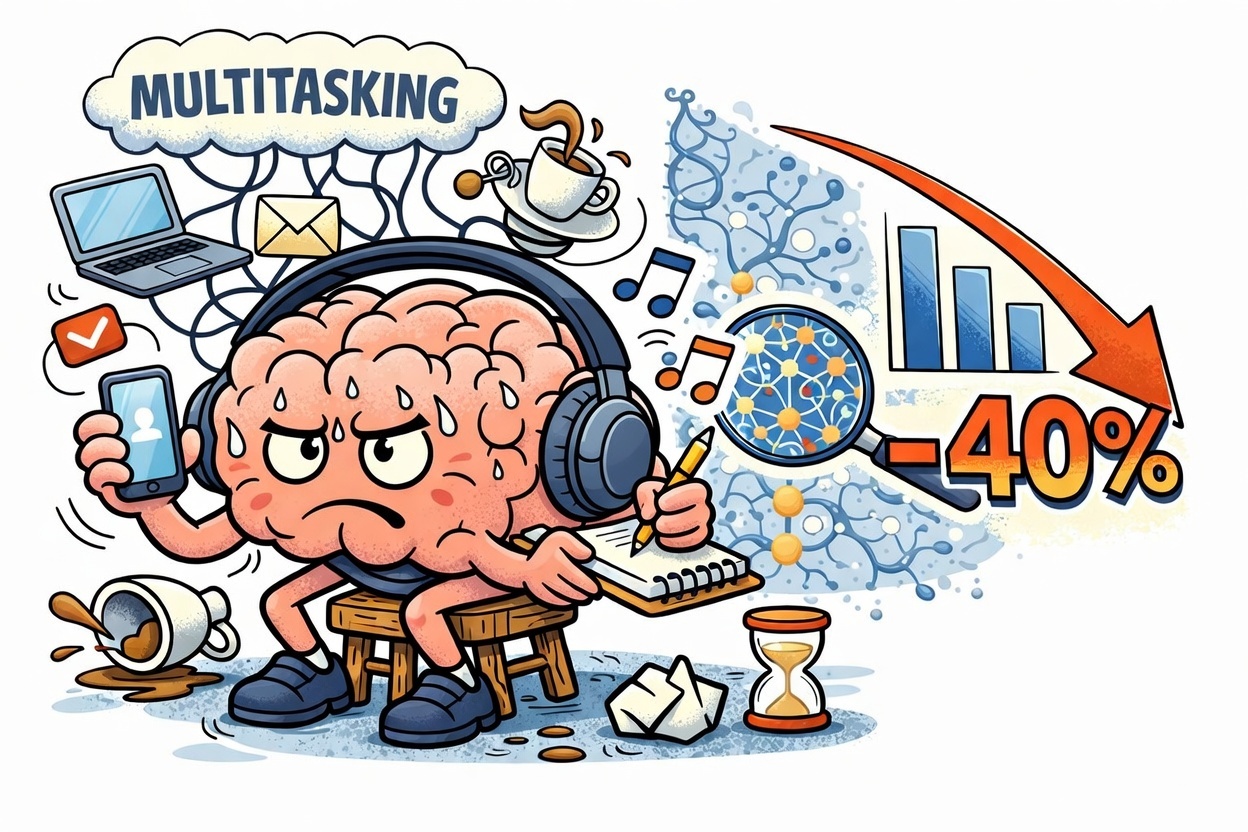
Why multitasking hurts focus
What feels like multitasking is actually rapid task switching in the brain. Each switch requires a mental reset, increases cognitive load, and often reduces attention, efficiency and reaction consistency.
| Scenario | Effect on attention | Typical outcome |
|---|---|---|
| Single-task focus | Stable top-down control | Consistent reaction time |
| Frequent notifications | Interrupted control | More variability |
| High multitasking | Context reload cost | More errors + slower responses |
What research says about multitasking
Research on multitasking consistently suggests that performance drops when attention is split between demanding tasks. In practice, the brain does not fully process multiple controlled tasks at the same time — it switches between them. That switching increases cognitive load, raises error rates, and often slows response speed.
This matters for cognitive testing because even small distractions can make reaction time less stable. A person may still have one fast response, but their average performance often becomes more variable. That is why repeated attempts and controlled conditions are more useful than judging attention from a single score.
What interference tests reveal
Tasks like the Stroop Test and Flanker Task measure your ability to resist distraction.
If distractions are strong, you often see higher error rates and slower reaction times.
How to measure attention reliably
- Use the same device each time.
- Compare averages across 5–10 attempts.
- Test in distraction-free vs distracted conditions.
Recommended tests
Measures response control and inhibition.
Measures processing speed and attention.
FAQ
Does multitasking reduce attention?
Yes. Multitasking usually means rapid task switching, and that increases cognitive load. The result is weaker sustained attention, more inconsistency, and a higher chance of mistakes.
Do distractions slow reaction time?
Often yes. Distractions interrupt focus, increase response variability, and can slow average reaction time, especially on tasks that require interference control.
How can I test my attention objectively?
Use structured tasks such as Reaction Time, Stroop, or Flanker tests. The most useful comparison is not one score, but your average across multiple attempts in similar conditions.
Does multitasking reduce productivity?
Usually yes. When you switch between demanding tasks, you lose time on mental reorientation, which can reduce accuracy, slow decisions and lower overall efficiency.