Yes. In a simple online visual reaction time test, an average of 200 ms is generally considered good and often slightly above average for adults. It is not elite-level fast, but it is clearly a solid result for a normal baseline.
Quick answer
If your average reaction time is around 200 ms, you are usually in the fast range for a simple visual task. The fairest comparison is to test on the same device and use a 10-shot average, not one lucky click.
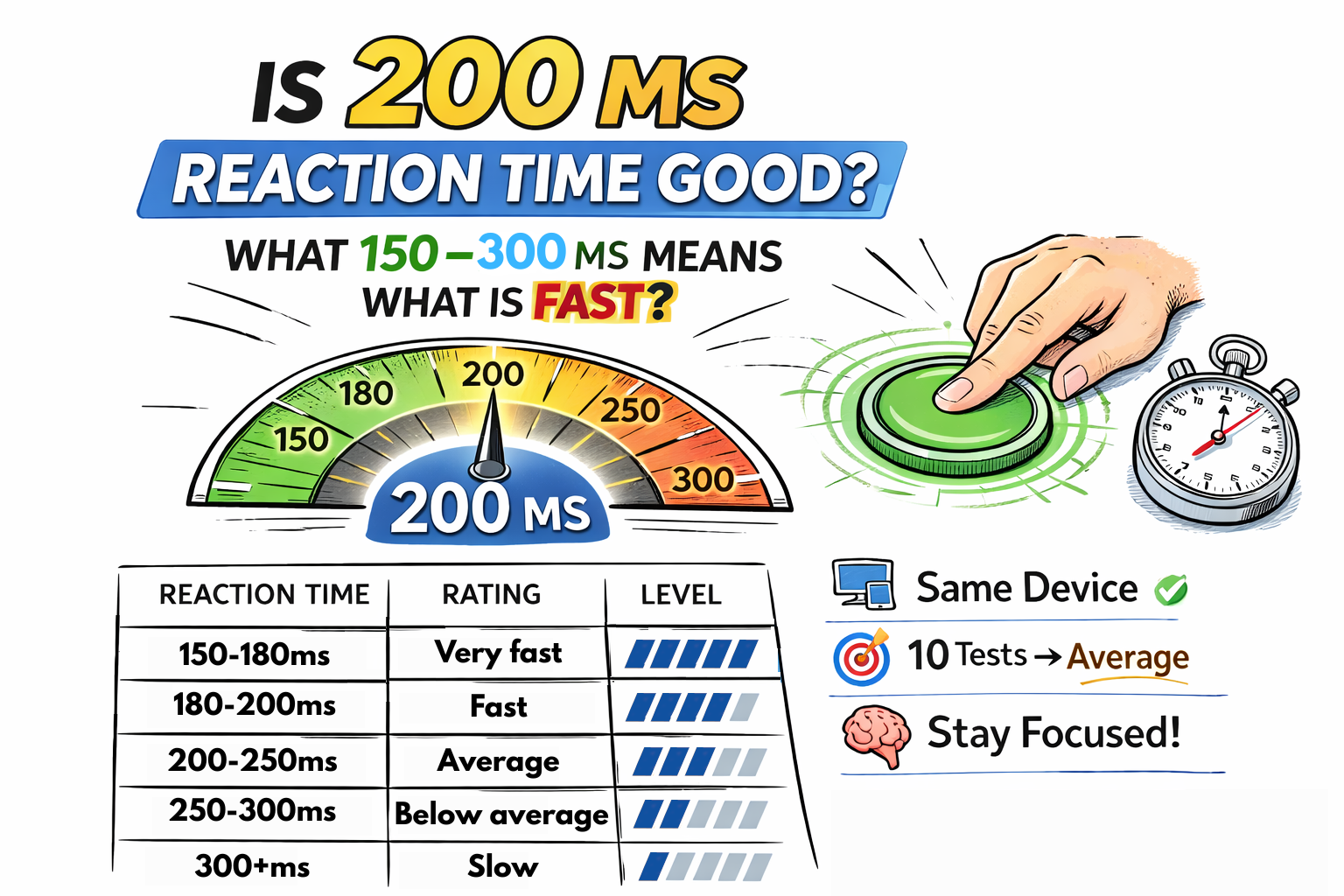
150 ms vs 180 ms vs 200 ms vs 250 ms vs 300 ms
Most people do not want theory first. They want to know whether their number is fast, average or slow. For a simple visual task like Reaction-1, this is a practical way to interpret it.
| Reaction time | Typical interpretation | What often explains it |
|---|---|---|
| 150–180 ms | Very fast | Practice, strong focus, low-latency setup, or sometimes anticipation |
| 180–200 ms | Fast / above average | Good focus, stable setup, repeated practice |
| 200–250 ms | Typical adult range | Normal baseline with day-to-day variation |
| 250–300 ms | Still normal for many people | Fatigue, distraction, stress, mobile delay |
| 300+ ms | Slower than typical baseline | Tired day, poor focus, multitasking, inconsistent setup |
What counts as a fast reaction time?
For a simple online visual task, a fast reaction time usually means under 200 ms as an average, not just one isolated score. A single fast click tells you very little. A clean 10-shot average tells you much more.
If you want to see whether training changes your baseline, read Can You Improve Reaction Time?.
Does age change whether 200 ms is good?
Yes. A score that looks average at one age can look excellent at another. Age does not explain everything, but it changes the baseline enough that it matters. For a more useful comparison, check Average Reaction Time by Age.
Is 200 ms good for gamers?
Yes, for many gamers 200 ms is a solid result. Competitive players sometimes post lower averages, but hardware, refresh rate, browser delay and practice all affect the number. If you want a tougher follow-up, compare your baseline on Reaction-1 with your performance on Reaction-2.
Is 250 ms reaction time bad?
No. 250 ms is still normal for many adults, especially on a phone or on a tired day. It is slower than a strong 200 ms average, but it is not automatically poor. What matters more is whether your score is stable and whether it improves when your conditions improve.
Is 150 ms reaction time realistic?
Yes, but it is less common as a stable average. Very low results can happen with practice and a fast setup, but repeated ultra-low numbers can also reflect anticipation. If you want to understand what the test is really measuring, read How Reaction Time Works.
How to compare your score fairly
- Use the same device every time if you want meaningful tracking.
- Use an average, ideally 10 shots, instead of judging one click.
- Test in similar conditions because sleep, stress and distraction matter.
Best tests to use next
Start with Reaction Test Level 1 for a clean speed baseline. Then use Reaction Test Level 2 for more control and inhibition. If you want broader attention testing, continue with Stroop, Flanker and Stop Signal.
FAQ
Is 200 ms reaction time good?
Yes. In a simple online visual reaction time test, a 200 ms average is generally considered good and often slightly above average for adults.
Is 250 ms reaction time bad?
No. Around 250 ms is still common for many adults, especially on mobile or on a tired day. It is better to compare repeated averages than one isolated result.
Is 150 ms reaction time realistic?
Yes, but it is less common as a stable average. Very low results may reflect strong practice, a fast setup or anticipation.
How should I compare reaction time fairly?
Use the same device, compare averages instead of one click, and test under similar conditions so your results mean something.
Educational only. Reaction time tests measure simple response speed, not intelligence or a medical condition. For useful tracking, compare averages on the same device across multiple days.