Chunking is one of the most useful memory techniques for remembering numbers. Instead of holding every digit separately, you turn a long sequence into a few smaller groups. That makes recall easier, especially in a number memory test, a digit span task, or any situation where you need to remember phone numbers, codes, or dates.
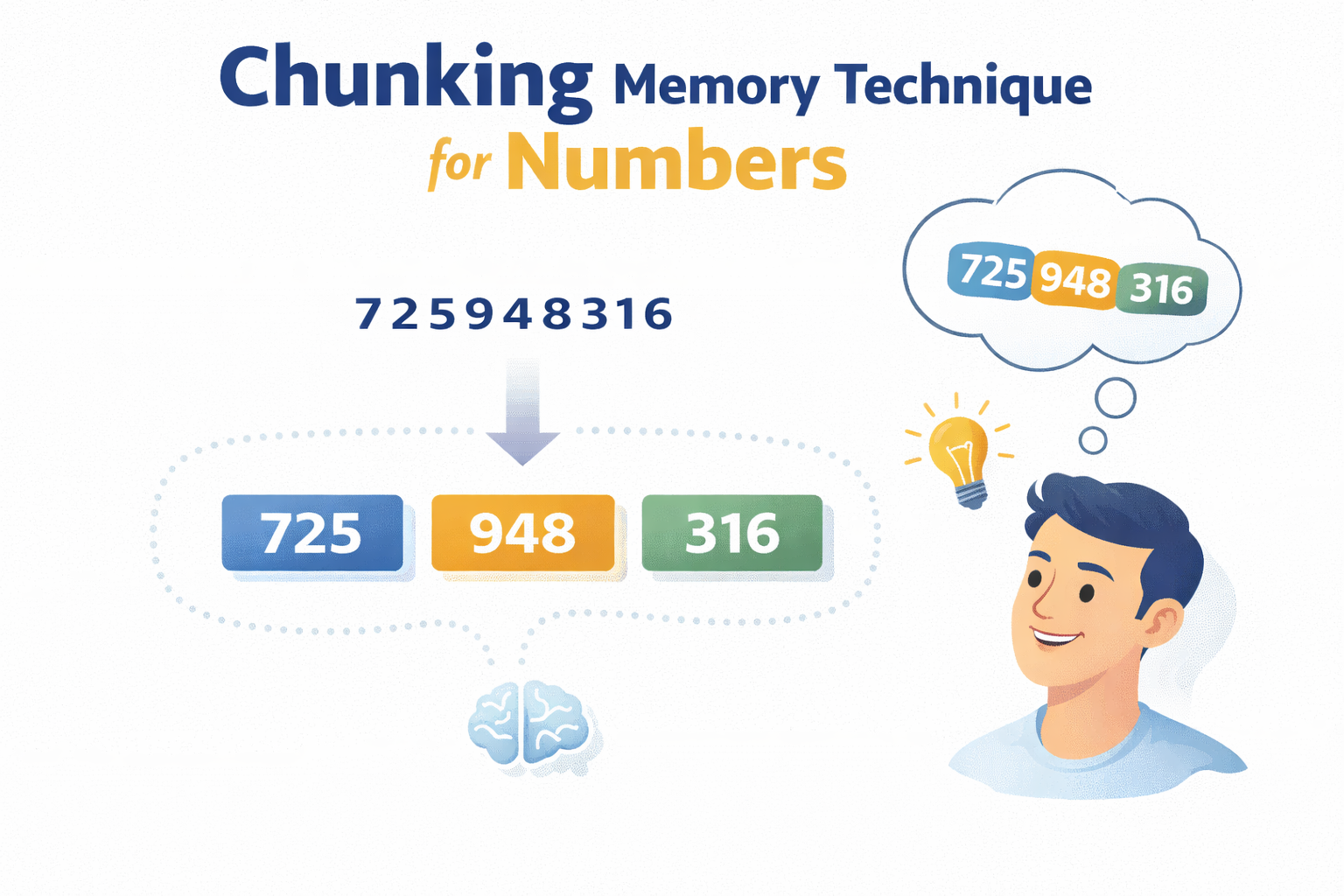
Quick answer: what is chunking?
Chunking means grouping many small items into a few larger units. For numbers, that usually means turning single digits into 2-digit or 3-digit chunks.
Jump to:
Chunking examples for remembering numbers
The main goal is simple: reduce the number of separate items your brain has to hold at once. The digits do not change. Only the way you organize them changes.
| Number sequence | Without chunking | With chunking |
|---|---|---|
| 7391842 | 7 / 3 / 9 / 1 / 8 / 4 / 2 | 739 / 18 / 42 |
| 12092001 | 1 / 2 / 0 / 9 / 2 / 0 / 0 / 1 | 12 / 09 / 2001 |
| 5559174021 | 5 / 5 / 5 / 9 / 1 / 7 / 4 / 0 / 2 / 1 | 555 / 917 / 4021 |
| 31415926 | 3 / 1 / 4 / 1 / 5 / 9 / 2 / 6 | 314 / 159 / 26 |
Why chunking works
Working memory is limited. When you try to remember a long number digit by digit, you use more mental slots. When you group the same sequence into a few meaningful blocks, the load becomes smaller.
That is why chunking often helps people who ask how to remember long numbers, how to improve digit span, or how to get better at a number memory test. It does not magically increase memory capacity, but it helps you use that capacity more efficiently.
How to use chunking step by step
- Choose a simple chunk size. Start with 2-digit or 3-digit groups.
- Keep the grouping stable. Do not change your format in the middle unless the last group is shorter.
- Read chunks as units. Think “739, 18, 42” instead of “7, 3, 9, 1, 8, 4, 2”.
- Use rhythm. A steady internal pace often makes recall cleaner.
- Look for meaning when possible. Dates, repeated patterns, or familiar number blocks are easier to remember.
Common chunking mistakes
- Changing chunk size mid-sequence. That creates extra confusion.
- Making chunks too large. Four-digit groups are fine for some people, but not for everyone.
- Overthinking the perfect pattern. Consistency is usually better than trying to invent a clever grouping every time.
- Judging yourself from one attempt. Memory tasks fluctuate, so trends matter more than one run.
Best tests to practise chunking
The most direct practice tool is the Number Memory Test, because it directly rewards better digit grouping and cleaner recall. You can also use the N-back Test to work on working memory under load, and the Memory Test 3×3 to balance verbal-number memory with visual memory practice.
What to expect
Chunking usually improves consistency before it dramatically improves your best score. In practice, that means fewer bad attempts, cleaner recall, and a more stable average.
If you are training seriously, keep your setup stable and compare repeated sessions over time. That gives you a much more honest view of progress than one unusually strong run.
FAQ
What is chunking in memory?
Chunking is a memory technique where you group separate digits or items into smaller blocks, so working memory holds fewer units at once.
Does chunking help you remember numbers better?
Yes. Chunking usually helps people remember longer number sequences because grouped digits are easier to hold and recall than isolated single digits.
What chunk size is best for number memory?
For most people, 2-digit or 3-digit chunks work best. The key is to stay consistent and use the same rhythm while encoding and recalling the sequence.
Is chunking useful for number memory tests?
Yes. Chunking is one of the most practical strategies for number memory and digit span tasks because it reduces mental load and improves consistency.
Educational only. The fairest comparison is your own repeated average on the same device, not one isolated result.